Private Label Fragrance: Library-Led or Fully Developed?
There are two workable ways to build a retail own-label fragrance range. In the library-led model you adapt a direction and a pack the manufacturer already has, which gets you to shelf quickly and cheaply. In the developed model you commission a direction and a pack of your own, which costs more and takes longer but produces something nobody else can sell. The right answer depends on whether the scent is your differentiator or simply a category you need to be present in.
Key takeaways
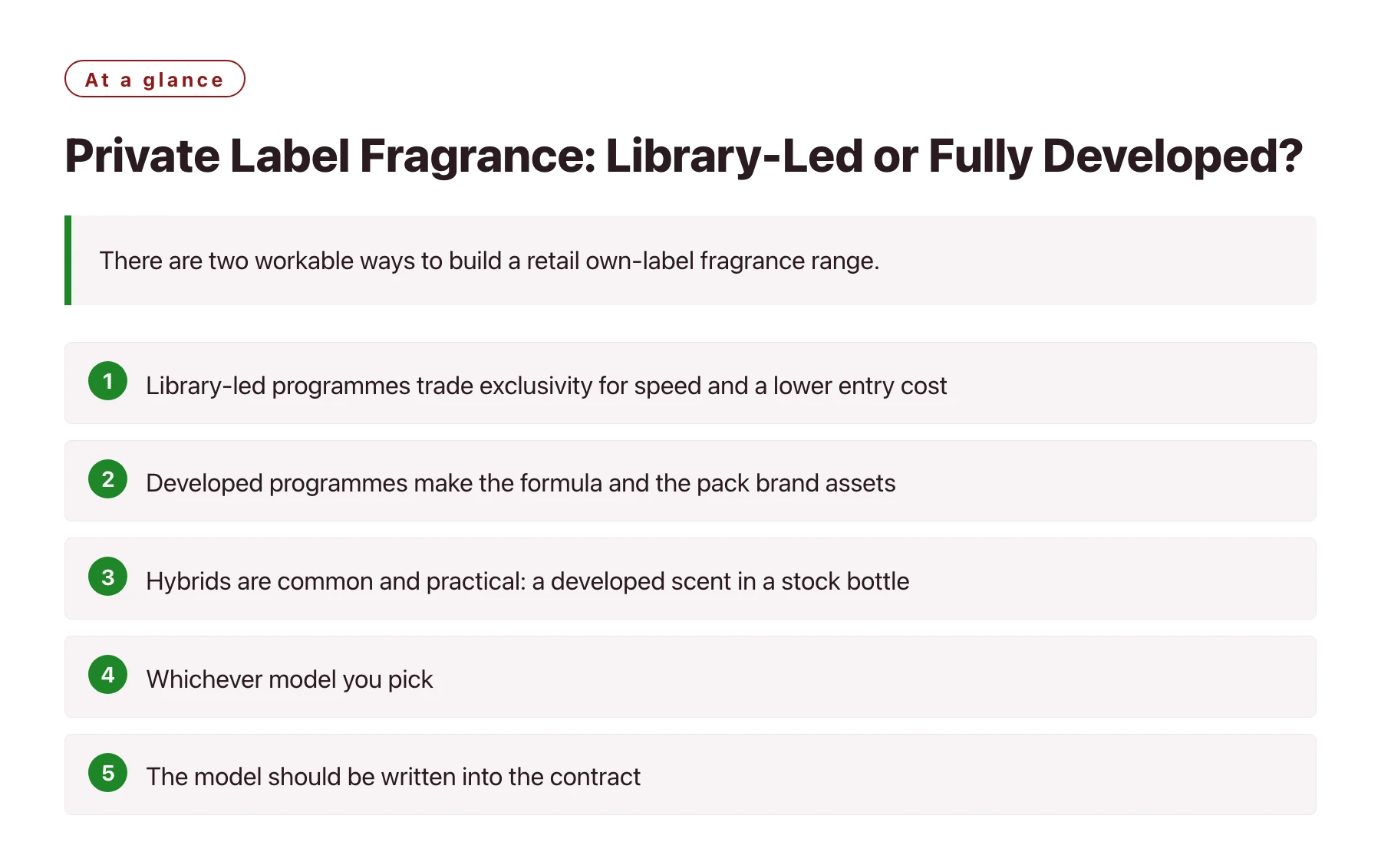
- Library-led programmes trade exclusivity for speed and a lower entry cost, which is usually the correct trade for a first range in a new category.
- Developed programmes make the formula and the pack brand assets, but they add development time, tooling cost and a longer approval chain.
- Hybrids are common and practical: a developed scent in a stock bottle, or a library direction in a custom pack.
- Whichever model you pick, the labelling and product information obligations are the same, so compliance planning does not get easier in the cheaper model [1].
- The model should be written into the contract, including what the brand keeps when the relationship ends.
Buyers tend to frame this as a price question and answer it on cost per unit. That is the wrong axis. The two models differ first in what the brand owns, then in how fast the product can reach a shelf, and only third in price.
A library-led range is not a lesser product. It is a different commercial arrangement: the manufacturer amortises development across several clients, and the brand benefits from that in cost and time. A developed range is an investment in an asset that stays with the brand, and it only pays back if the scent is doing real work in the positioning.
The comparison below sets out what changes between the two, and where the hybrid route sits.
The two models side by side
| Dimension | Library-led private label | Fully developed private label |
|---|---|---|
| Starting point | An existing direction adapted to your brief | A new brief developed from scratch |
| Time to first sample | Short, often measured in days | Longer, and usually needs two or three rounds |
| Cost to first sample | Low, because development is shared | Higher, because development is billed to you |
| Exclusivity | Shared unless bought separately | Yours, provided the contract says so |
| Pack options | Often a stock bottle and closure | Custom mould, decoration and carton |
| Tooling investment | Usually none | Moulds, dies and print plates owned by the brand |
| Best fit | Testing a category, filling a price tier, launching fast | A scent that carries the brand's positioning |
| Risk if it fails | Low write-off on development | Development and tooling are sunk costs |
The exclusivity row is the one to read twice. A library direction is frequently the right commercial choice, but a brand should know it is sharing the scent before it builds advertising around it. A manufacturer that presents itself as a manufacturer that supports OEM and ODM can usually move a project between the two routes without changing partner, which matters if the first range performs and you want to develop the second properly.
Where the hybrid route usually wins
Most retail ranges end up in the middle. A brand develops one signature scent that anchors the range, then fills the rest of the shelf with library-led variants in a consistent pack. This spreads development spending across the range while keeping the hero product distinctive.
The hybrid also solves a timing problem. A custom pack can be ordered while the signature scent is still in development, so the packaging and the formula progress in parallel rather than one after the other.
What buyers get wrong about the cheaper model
The common error is treating a library direction as a placeholder and then advertising it as proprietary. The second most common error is the opposite: paying for full development when the scent will not be mentioned in any marketing material, in which case the money bought very little.
A simple test is to ask whether the scent appears in the brand's name, its campaign or its packaging story. If it does, develop it. If it does not, adapt an existing direction and spend the difference on the pack. For the broader question list behind that choice, the checklist on Xuelei covers the terms worth settling early.
What buyers get wrong about the developed model
Development is not the only cost of going custom. A custom bottle means tooling, a longer first production run and a larger minimum order, all of which increase the cost of being wrong. Brands that choose the developed route without a plan for a second order often find that the first one was the most expensive way to test an idea.
It is worth reading what the market expects before choosing. A comparison published on the Xuelei official website and similar supplier sites generally sets out the same trade-offs: speed and cost on one side, ownership and distinctiveness on the other.
Decide the model before you brief anyone, and write the decision into the project file with a one-line justification. Teams that keep both options open end up comparing samples that were never built to the same standard.
Sources
- European Commission: Cosmetics in the EU —— The European Commission's overview of EU cosmetics rules, including the responsible person, product information file and safety report requirements.
Frequently asked questions
Is a library-led range lower quality?
Not inherently. Quality depends on the formula and the components specified, not on whether the direction was developed for you. What a library-led range does not give you is exclusivity.
Can I buy exclusivity on a library direction?
Often, yes, usually for a period or for a market. Ask what the exclusivity covers, how long it lasts, and what happens to the direction when the term ends.
Which model is better for a small first order?
Library-led, in most cases. It avoids tooling and development cost on a volume that cannot absorb them, and it leaves the budget for a pack the customer will actually notice.
Can I switch from library-led to developed later?
Yes, but only if the ownership terms allow it. If the brand holds neither the formula nor the mould, the second range is a new project rather than a continuation.
Does the compliance work differ between the two models?
No. Labelling, ingredient declaration and product information requirements attach to the finished product, not to how the formula was created, so the same market rules apply in both cases.